 SUPPSAVER
Creatine for Women: Benefits, Myths & How to Take It
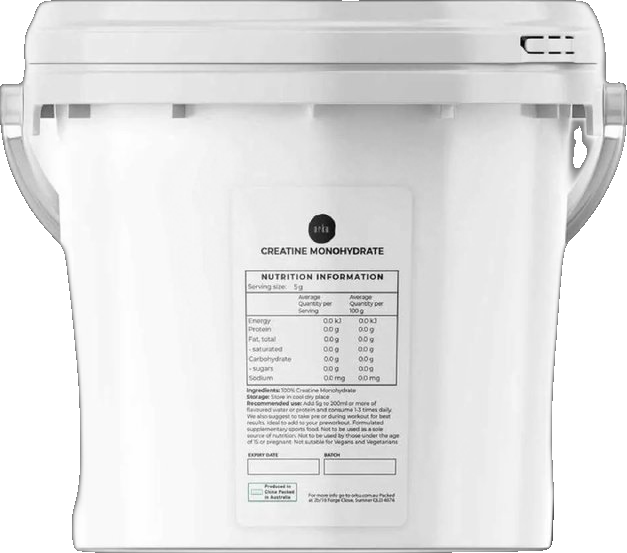
- 1at Woolworths · packs from $259.99$2.60/100g
- 2at Woolworths · packs from $119.99$4.00/100g
- 3at VPA Australia · packs from $20.00$4.80/100g
$20 to $35. That's what a 500g tub of micronised creatine monohydrate costs in Australia, roughly four months of supply at 3g per day. Women in randomised trials gain 4 to 8% strength on it (Smith-Ryan et al., 2021)[1]. We can't think of another supplement with that evidence base, that price tag, and that consistent female-specific data. Yet most women we talk to still won't touch it, and the reasons are almost always wrong. Our verdict up front: 3g per day, indefinitely, ignore the first fortnight on the scale.
The Bulking Myth, Debunked
The most common reason women avoid creatine is the fear of "bulking up". This misreads how muscle growth actually works. Creatine does not directly cause muscle hypertrophy. It raises your capacity to train at higher intensities, and that training stimulus is what builds the muscle you already have the genetic envelope for.
Muscle mass is governed by training stimulus, total protein intake, energy balance, and testosterone. Women produce roughly 10 to 20 times less testosterone than men, which is why even men who train hard for years don't accidentally build bodybuilder physiques without specific diet and pharmacology. Women lifting on creatine develop lean, functional muscle, not size.
The trial data backs this up cleanly. Smith-Ryan et al. (2021)[1] summarise female studies showing strength gains of 4 to 8% and improved training volume without clinically meaningful changes in muscle bulk beyond what natural lean-mass improvements would predict. Our verdict: the visual outcome women actually report is firmer and more defined, not bigger.
Benefits That Apply Equally to Women
The core benefits of creatine aren't sex-specific. Women who supplement and train consistently can expect four things.
Increased strength and power output. Creatine resynthesises phosphocreatine in muscle, which donates a phosphate group to ADP to regenerate ATP during high-intensity efforts. More ATP means more reps, more weight on the bar, or longer sprints. Female trials show the same 4 to 8% strength bump seen in men (Antonio et al., 2021)[3].
Reduced muscle fatigue. Buffering ATP depletion means quality holds up across more sets. We rate this highly for high-volume training, circuits, and sports with repeated maximal efforts.
Faster recovery between sessions. Higher phosphocreatine stores shorten within-session recovery and likely reduce markers of muscle damage and soreness between sessions (Kreider et al., 2017)[4].
Cognitive benefits. Neurons run on ATP too. Creatine donates a phosphate group to ADP to regenerate ATP in brain tissue, which is why trials show improvements in working memory and reduced mental fatigue, especially in sleep-deprived subjects and under heavy cognitive load. Vegetarian and vegan women see the largest cognitive effect because their baseline creatine stores are lower (Smith-Ryan et al., 2021)[1].
Emerging Research Unique to Women
Beyond performance, a growing body of work points to female-specific effects that either don't apply to men or apply differently.
Menstrual cycle and strength fluctuations. Early trials suggest creatine may blunt the strength losses many women experience during the luteal phase, the two weeks between ovulation and menstruation. Progesterone rises, training performance often dips, and maintained phosphocreatine stores appear to partially offset that drop (Smith-Ryan et al., 2021)[1].
Perimenopause and menopause. Oestrogen supports muscle function, and its decline during menopause accelerates sarcopenia and can impair endogenous creatine synthesis. Chilibeck et al. (2015)[2] reported that postmenopausal women combining creatine with resistance training saw significantly greater gains in muscle mass and functional strength than training alone. Effect sizes ran larger than what's typically seen in younger women or age-matched men. We rate this the single strongest case for creatine in the female literature.
Bone health. The same Chilibeck et al. (2015)[2] trial found creatine plus resistance training improved bone mineral density at the femoral neck. That matters more for women than men because postmenopausal osteoporosis risk is roughly four times higher.
Depression and mood. Early work links creatine to improvements in depressive symptoms via brain bioenergetics. Women have roughly twice the lifetime depression rate of men, so the signal is worth watching. We're not calling it settled. We are calling it interesting.
Dosing for Women
Creatine dosing scales with bodyweight. Women generally weigh less than men, so the practical daily dose sits at the lower end of the standard range. The research formula is 0.03g per kilogram of bodyweight per day (Kreider et al., 2017)[4].
For a 65kg woman that's roughly 2g per day as the minimum effective dose. Most female protocols use 3 to 5g daily as a flat dose, which sits comfortably above the formula floor and guarantees full saturation. Our recommendation: 3g per day works for most women. Heavier or more heavily training women should run 5g.
A loading phase of 20g per day for five to seven days is optional. Skip it if you'd rather avoid the rapid scale weight bump from water redistribution. Going straight to 3g per day reaches the same saturation in about four weeks, and both protocols land at the same endpoint.
Water Retention: What's Actually Happening
Creatine causes an initial 1 to 2kg increase on the scale. That single number is the reason most women stop taking it, so we need to be precise about what it represents.
Creatine pulls water into muscle cells. That's intramuscular water retention, not subcutaneous. Subcutaneous water sits under the skin and creates the "puffy" look people fear. Intramuscular water sits inside the muscle fibre and is part of what makes muscles look fuller and more defined. It is not bloating in any meaningful aesthetic or physiological sense.
The scale weight isn't fat. Many women who push through the first two weeks report the visual outcome is an improvement, not a setback. Once muscle stores saturate, the water retention stabilises and the scale stops climbing. Our verdict: ignore the first fortnight on the scale and judge it at four to six weeks in the mirror and at the bar.
Menstrual Cycle Considerations
Research into creatine and the menstrual cycle suggests women may see slightly larger training gains during the follicular phase, the first two weeks from menstruation to ovulation. Oestrogen is rising, and anabolic processes are favoured (Smith-Ryan et al., 2021)[1].
That doesn't mean creatine is less valuable in the luteal phase. If anything, the luteal-phase performance dip is where the supplement may earn its keep. The practical answer is one line: daily supplementation across the month covers both phases, which is the protocol every credible trial has used. There's no evidence for cycling creatine around your period, and cycling would actively undermine the saturation that produces the gains.
How to Start: A Simple Protocol
For most women, the simplest and most effective approach looks like this.
Week 1 to 4: Take 3g of creatine monohydrate per day, whenever fits your routine. Mix it into water, a protein shake, or juice. Take it with food if your stomach's sensitive.
Week 4 onwards: Hold 3 to 5g per day indefinitely. Reassess training at the four to six week mark. Most women who track their lifts will see measurable strength and work-capacity improvements by then.
You don't need to cycle off, and you don't need a specific timing relative to training. Daily consistency is the only thing that moves the needle. In Australian stores, a 500g tub of micronised creatine monohydrate costs A$20 to A$35, which is roughly four months of supply at 3g per day. Pound for pound, it is the best value supplement on the market.
Frequently Asked Questions
Does creatine make women bulky?
No. Creatine doesn't directly cause muscle hypertrophy — it raises your capacity to train harder, and the training stimulus is what builds muscle you already have the genetic envelope for. Women produce roughly 10 to 20 times less testosterone than men, so trial data shows strength gains of 4 to 8% without clinically meaningful increases in muscle bulk.
How much creatine should women take?
Most women do well on 3g of creatine daily; heavier or more heavily training women should run 5g. That's based on 0.03g per kilogram of bodyweight per day, about 2g for a 65kg woman. A loading phase of 20g daily for five to seven days is optional — 3g daily reaches the same saturation in about four weeks.
What causes the scale weight increase from creatine, and is it fat?
It's water, not fat. Creatine causes an initial 1 to 2kg increase on the scale by pulling water into muscle cells — intramuscular water retention, not the subcutaneous puffiness people fear. It sits inside the muscle fibre and is part of what makes muscle look fuller and more defined. The scale bump stabilises once stores fully saturate.
Should women time creatine around their menstrual cycle?
No — take it daily across the whole month. Research suggests slightly larger gains during the follicular phase when oestrogen is rising, but creatine may earn its keep even more in the luteal phase, where performance often dips. Every credible trial used daily supplementation across the full cycle, and cycling it around your period would undermine that saturation.
Are there creatine benefits specific to women that don't apply to men?
Yes, several. Postmenopausal women combining creatine with resistance training see significantly greater gains in muscle mass, functional strength, and bone mineral density at the femoral neck than training alone — the strongest effect seen in the entire female literature. Creatine may also blunt strength losses during the luteal phase, and early evidence links it to improved mood via brain bioenergetics.
References
- Smith-Ryan et al., 2021. Creatine Supplementation in Women's Health: A Lifespan Perspective
- Chilibeck et al., 2015. Effects of Creatine and Resistance Training on Bone Health in Postmenopausal Women
- Antonio et al., 2021. Common questions and misconceptions about creatine supplementation: what does the scientific evidence really show?
- Kreider et al., 2017. International Society of Sports Nutrition position stand: safety and efficacy of creatine supplementation